
| Product classification | Pharmaceutical Intermediates >> Diphenylamine Intermediates |
|---|---|
| English name | 4,4′-Methylenebis(N-sec-butylaniline) |
| Alias | N-butan-2-yl-4-[[4-(butan-2-ylamino)phenyl]methyl]aniline |
| Product Name | 4,4′-Methylene bis(N-Secondary butylaniline) |
| molecular structure | 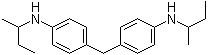 |
| Formula | C9:30P.M.N 2 |
| molecular weight | 310.48 |
| CAS login number | 5285-60-9 |
| EC number | 226-122-6 |
| Enter the shortcode SMILES in the molecular line |
CCC(C)NC1=CC=C(C=C1)CC2=CC=C(C=C2)NC(C)CC |
| Solubility | 0.06903 mg/L (25 ºC water) |
|---|---|
| Density | 1.0±0.1 g/cm3, calculated value* |
| Refractive index | 1.581, Calculated value* |
| Melting point | 143.50 ºC |
| Boiling point | 458.2±38.0 °C (760 mmHg), 计算值*, 404.47 °C |
| Flashpoint | 272.3±18.6 ºC, calculated value* |
| 4,4′-Methylene bis(N-mid-butylaniline), commonly known as MBBA, is an organic compound that has attracted attention in the fields of polymer chemistry and materials science. The substance was first synthesized in the mid-20th century as part of research efforts aimed at developing advanced polymers with enhanced properties. Its structure consists of two N-secondary butylaniline groups connected by methylene bridges, which contribute to its unique chemical behavior and function.
The discovery of 4,4′-methylene bis(N-secondary butylaniline) stemmed from the need for effective curing agents and hardeners in epoxy resins. This compound exhibits excellent reactivity with epoxy functional groups, making it an essential ingredient in thermoset plastic formulations. Its ability to facilitate cross-linking of epoxy systems has made it possible to develop materials with improved mechanical properties, chemical resistance, and thermal stability. One of the primary applications of MBBA is the manufacturing of high-performance adhesives and coatings. These formulations benefit from the compound’s ability to enhance bond strength and durability, especially in demanding environments that require exposure to moisture, heat, and chemicals. Incorporating 4,4′-methylene bis(N-secondary butylaniline) into adhesive formulations gives the product excellent bond strength and durability, making it suitable for industries such as automotive, aerospace, and construction. In addition to its role in adhesives, 4,4′-methylene bis(N-secondary butylaniline) is also used in the production of composites. When used as a curing agent in epoxy resins, it helps to form highly cross-linked networks that provide excellent structural integrity. These properties make composites containing MBBA ideal for applications where high strength-to-weight ratios are essential, such as aerospace components, sporting goods, and industrial equipment. Another important application of this compound is in the field of coatings. The use of 4,4′-methylene bis(N-secondary butylaniline) in coating formulations improves abrasion, impact, and chemical resistance, thereby extending the life of the coating surface. This is particularly beneficial in automotive paintings and industrial coatings, where durability and aesthetics are paramount. The compatibility of 4,4′-methylene bis(N-mid-butylaniline) with various polymer systems further enhances its versatility. It can be blended with different resins to tailor the performance of the final product to specific application requirements. This adaptability makes MBBAs a preferred choice for formulators seeking to optimize material properties. Despite its numerous advantages, 4,4′-methylene bis(N-mid-butylaniline) must be used with caution due to the potential health and safety concerns associated with amine compounds. Proper handling methods and safety measures are essential to mitigate any risks associated with exposure during production and application. Ongoing research aims to explore further applications of 4,4′-methylene bis(N-secondary butylaniline) in emerging fields such as nanocomposites and bio-based materials. As sustainability becomes increasingly important in material development, the potential for using MBBA in eco-friendly formulations represents an exciting avenue for future innovations. In conclusion, 4,4′-Methylene Bis(N-Secondary Butylaniline) plays a crucial role in advancing polymer technology, particularly in the development of high-performance adhesives, coatings, and composites. Its discovery and subsequent applications reflect the evolving landscape of materials science, driven by the demand for durable and efficient products across various industries. Polyurethane: It can enhance the tensile strength in soft foams and the compressive strength and closed-cell ratio in hard foams. Polyurea: It delays the gelation reaction and enhances the coating adhesion and impact resistance. Intrapermolysis: The secondary butyl group has an intrapermolysis effect, improving the material’s flexibility. Reactivity: The amino group can react with isocyanates to form conjugated-occupancy urea bonds, forming dynamic cross-links.
Polyurethane soft foam, hard foam Coatings, adhesives, elastomers Epoxy resin system (as its derivative)
It can be used for low-toxicity hard foaming, coatings, sealants, elastomers, polyurea spraying. It has low toxicity, improved fluidity and adhesion, low temperature sensitivity, high compatibility with various polyols and polyurethane raw materials, increased foam compression strength, dimensional stability, reduced brittleness, high closed-cell ratio, and low thermal conductivity. |

